Homo Udakan: Difference between revisions
No edit summary |
No edit summary |
||
| Line 1: | Line 1: | ||
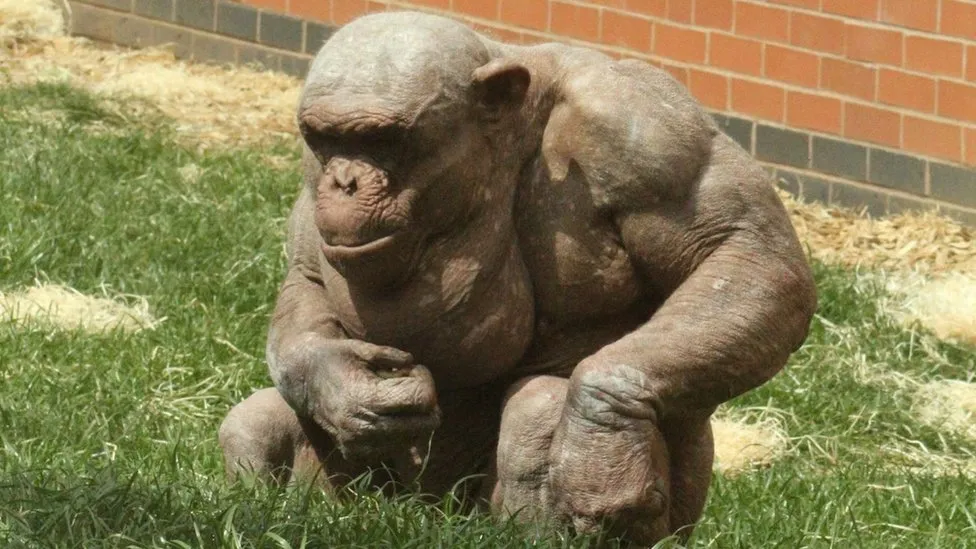
Udakan Valkai is the native home of numerous extraterrestrial primates, including orders that resemble Lemuriformes and Haplorhini. The dominant, most technologically-advanced beings belong to the genus Homo Udakan. These Udakan humans equal Homo sapiens in intelligence but perhaps more closely physically resemble Homo heidelbergensis, Homo neanderthalensis, and/or Homo antecessor. Their muscular, robust bodies have comparatively wider hips, shorter limbs, and barrel chests. Their faces are longer from top to bottom, but, like Homo sapiens, they have chins and their cheekbones curve as they merge into the upper jaw. While they have four fewer teeth than their Homo sapien counterparts, their teeth are larger and their jaws project farther outwards. Most strikingly different is the dark-hued sclera of Homo udakan and tannish grey skin color, [https://ichef.bbci.co.uk/news/976/cpsprodpb/106DF/production/_90559276_mongo2jakebeaton-rekkers.jpg.webp much like a hairless chimp]. Natural variation of sclera includes amber, brown, green, and hazel; white is occasionally found. Freckles are black. | Udakan Valkai is the native home of numerous extraterrestrial primates, including orders that resemble Lemuriformes and Haplorhini. The dominant, most technologically-advanced beings belong to the genus Homo Udakan. These Udakan humans equal Homo sapiens in intelligence but perhaps more closely physically resemble Homo heidelbergensis, Homo neanderthalensis, and/or Homo antecessor. Their muscular, robust bodies have comparatively wider hips, shorter limbs, and barrel chests. Their faces are longer from top to bottom, but, like Homo sapiens, they have chins and their cheekbones curve as they merge into the upper jaw. While they have four fewer teeth than their Homo sapien counterparts, their teeth are larger and their jaws project farther outwards. Most strikingly different is the dark-hued sclera of Homo udakan and tannish grey skin color, [https://ichef.bbci.co.uk/news/976/cpsprodpb/106DF/production/_90559276_mongo2jakebeaton-rekkers.jpg.webp much like a hairless chimp]. Natural variation of sclera includes amber, brown, green, and hazel; white is occasionally found. Freckles are black. | ||
The metabolism of Homo Udakan is quite different than Homo sapiens. Homo Udakan typically eat once a day or less, but can store energy for far longer after a large meal. | The metabolism of Homo Udakan is quite different than Homo sapiens. Homo Udakan typically eat once a day or less, but can store energy for far longer after a large meal. There is a custom on feast days to accept and gorge on a host's food at whatever personal cost. They can also enter states of deep torpor when sleeping, their body temperatures and metabolic rates falling to conserve energy. '''Question: Do they practice daily torpor i.e. less than 24 hours or does it last for days to weeks during the winter or the summer? During this time, [https://en.wikipedia.org/wiki/Embryonic_diapause can pregnancies safely pause]?''' | ||
Most inhabitants of Udakan Valkai can create their own vitamin C, including the Homo Udakan. When Homo Udakan travel to planes where vitamin C is plentiful in food, they tend to avoid eating. Overdosing on vitamin C is not fatal but can be extremely uncomfortable. | |||
The Restless Dead cannot create their own vitamin C and crave the vitamin C of the living. | |||
[[Category:Game]] | [[Category:Game]] | ||
Revision as of 00:47, 13 May 2023
Udakan Valkai is the native home of numerous extraterrestrial primates, including orders that resemble Lemuriformes and Haplorhini. The dominant, most technologically-advanced beings belong to the genus Homo Udakan. These Udakan humans equal Homo sapiens in intelligence but perhaps more closely physically resemble Homo heidelbergensis, Homo neanderthalensis, and/or Homo antecessor. Their muscular, robust bodies have comparatively wider hips, shorter limbs, and barrel chests. Their faces are longer from top to bottom, but, like Homo sapiens, they have chins and their cheekbones curve as they merge into the upper jaw. While they have four fewer teeth than their Homo sapien counterparts, their teeth are larger and their jaws project farther outwards. Most strikingly different is the dark-hued sclera of Homo udakan and tannish grey skin color, much like a hairless chimp. Natural variation of sclera includes amber, brown, green, and hazel; white is occasionally found. Freckles are black.
The metabolism of Homo Udakan is quite different than Homo sapiens. Homo Udakan typically eat once a day or less, but can store energy for far longer after a large meal. There is a custom on feast days to accept and gorge on a host's food at whatever personal cost. They can also enter states of deep torpor when sleeping, their body temperatures and metabolic rates falling to conserve energy. Question: Do they practice daily torpor i.e. less than 24 hours or does it last for days to weeks during the winter or the summer? During this time, can pregnancies safely pause?
Most inhabitants of Udakan Valkai can create their own vitamin C, including the Homo Udakan. When Homo Udakan travel to planes where vitamin C is plentiful in food, they tend to avoid eating. Overdosing on vitamin C is not fatal but can be extremely uncomfortable.
The Restless Dead cannot create their own vitamin C and crave the vitamin C of the living.